
Rooster Knows the Threshold
There is a still moment before the rooster crows. When the sky holds its breath, he lifts his voice into the dark and declares: Now.
He knows thresholds — the margins between dark and dawn, where instinct blossoms into awareness, where the forest yields to the village. He knows what it means to be both the watcher and the watched.
A living heir of the dinosaurs, Rooster traces his lineage to the Red Junglefowl of the Southeast Asian forests, where the canopy parts and the first light falls.
As he traveled from Asian forest to Greece and Rome, across West Africa and the Caribbean, from China to the Americas, he became known as the keeper of time, the guardian of the threshold, the one who names the moment when the night must yield.
His Ancient Body Was Built for This
To appreciate Rooster, you must understand his eyes.
He does not see the world you see. He sees more.
His eyes see a world beyond your imagination. Where you perceive color, he perceives more — an opening into the ultraviolet, into light that floods the world just beyond the edge of human sight. It isn't darkness. It isn't absence. It is more of what is already there, flooding the world with information we simply cannot access. We stand before a boundary we experience as solid. He perceives what lies beyond its limits.
In ultraviolet light, a plain brown hen pulses with pattern. The health of his flock, the vitality of a rival, the particular signature of a hawk against the morning sky — all of it readable, precise, arriving before shape or size has fully resolved. He is not guessing. He is not anxious. He is reading a frequency we do not possess.
And then there is this: he may be crowing into a darkness that is, to his full perceptual system, already brightening. Roosters carry light receptors not only in their eyes but in the brain itself — photoreceptors that detect light through the skull. He may be reading the UV shift in the sky that precedes visible dawn, calling the light before we can see it coming.
He calls the moment before the moment arrives.
He Holds Two Worlds at Once
One eye tilts toward the earth — the grain, the ground, the immediate needs of the flock. The other tilts toward the sky — the horizon, the weather gathering, the shadow that might be nothing or might be everything. He does not choose between near and far, between now and what is coming. He holds both, simultaneously, without confusion.
This is what it means to be the guardian of the threshold.
The hawk does not surprise him. In ultraviolet, subtle contrasts and patterns emerge—signals that sharpen awareness long before ordinary sight would sound the alarm. His call comes not from panic but from information — precise, differentiated, already read and understood before the danger fully forms. The flock knows to trust it because it has never been idle noise.
He was built for this. Ancient body, ancient eyes, ancient knowing.
What Rooster Wants You to Know
Deep within your skull, behind the seeing, lives an ancient eye—older than thought, older than language. It does not open to light. It opens to stillness. To attention. In distant evolutionary ancestors, it sensed the sky directly. You carry it still, turned inward now. A dreaming eye. Gurus and philosophers the world over have called it the third eye. Find stillness. Pay attention to the dreaming. That is where the people find the "power to redeem the work of fools."
“I was dreaming in my dreaming.” — Patti Smith, People Have the Power
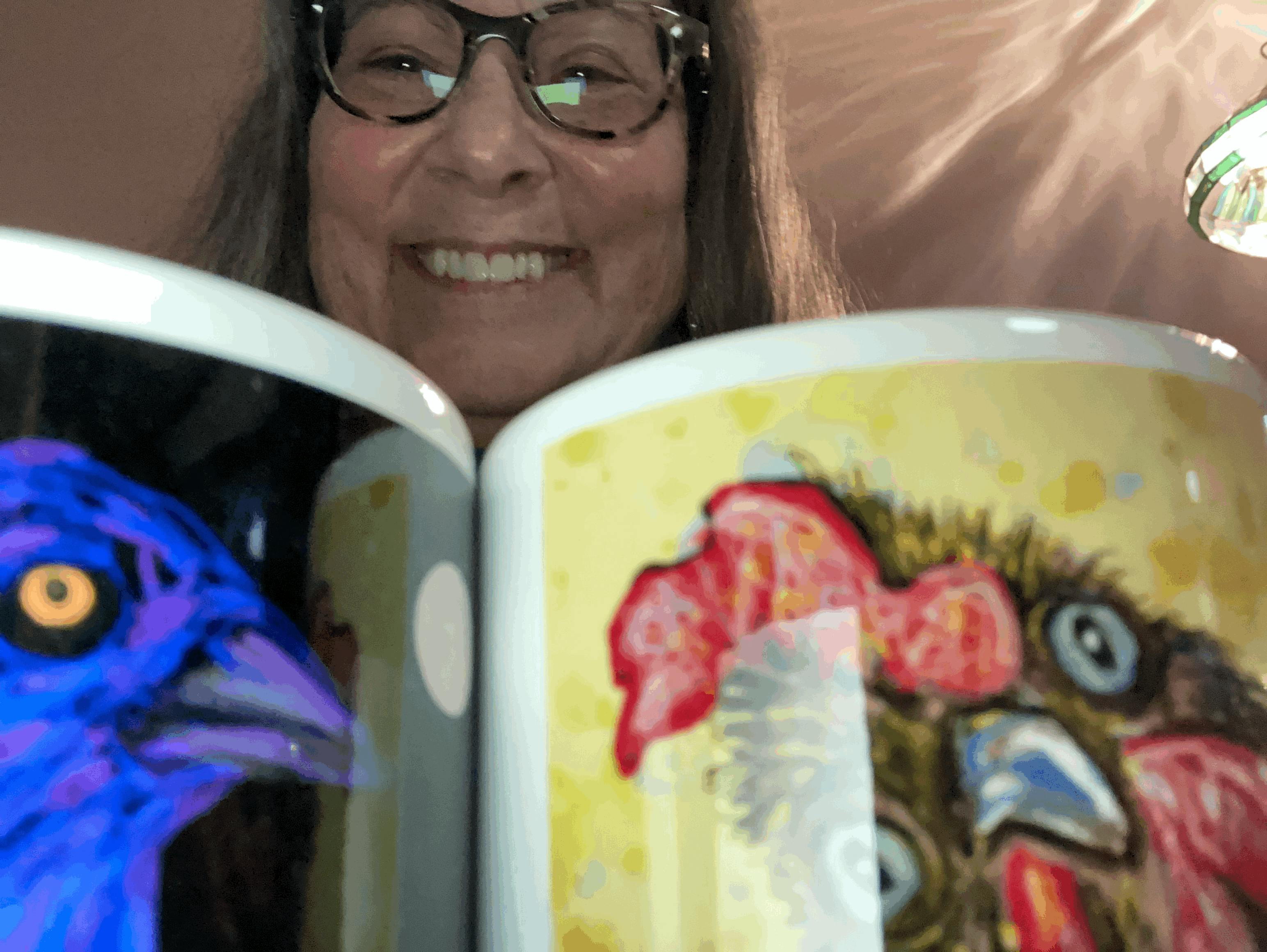
If Rooster calls you, explore the Rooster collection.