It began the day I had to stop teaching.
The world was closing down. Like so many others, I found myself sitting on the edge of something I hadn’t chosen.
I sat on my bed and asked a simple question:
What now?
I always said that one day I would give more time to my art. But “one day” has a way of drifting.
What came back to me, clear and unmistakable, was this:
If not now, when?
At my age, time is no longer an abstract idea. It has weight. It asks to be used.
That day, I reorganized my space and began.
At first, it was practice.
I listened, I learned, I followed the quiet discipline of showing up. One of the artists I studied spoke about inviting the Muse—not by waiting, but by working where she could see you.
So I worked.I painted pears. Over and over again.
I would prepare the night before—paper stretched, tools laid out, colors chosen—
so that when I arrived, the work was already waiting.
And something shifted.
The act of painting began to call more painting. The work itself became the invitation.
Then, at Christmas, my daughter gave me an iPad.
I was curious what would happen if I moved into a digital space—whether it might open something new.
When I asked myself what I wanted to paint next, the answer surprised me.
Animals.
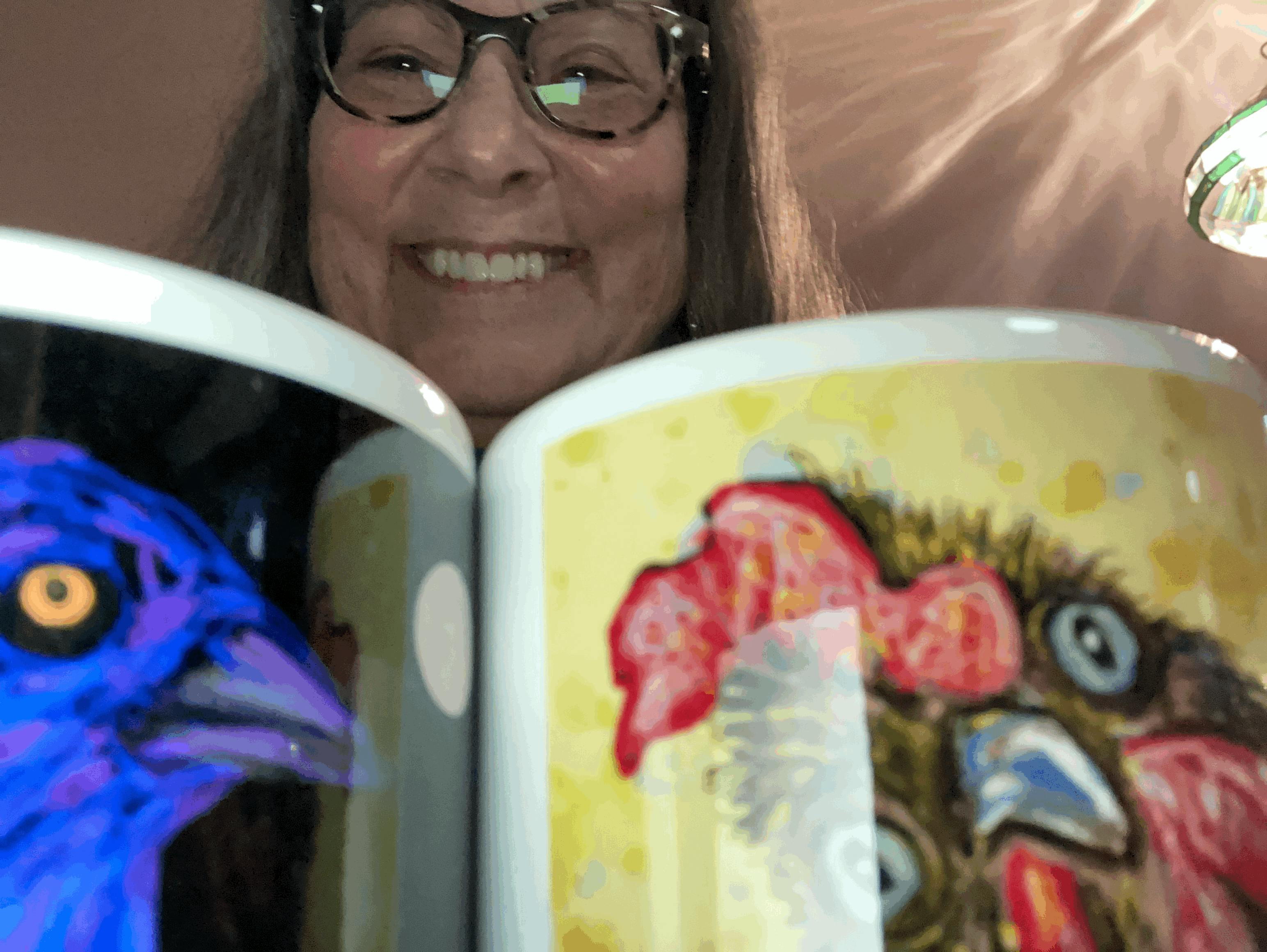
The first was a rooster.
I didn’t choose him consciously. But when I finished, I recognized him.
He came from a childhood memory—a song our mother’s helper used to sing to us:
Chickema chickema scrany scrow.
Somehow, he had been waiting there all along.
As I sat with the image, another thought came: He wanted to be on a mug. So I figured out how to do that.
And then something even more unexpected began to happen. The animals kept coming.
And they started talking to me.
Around that time, my granddaughter mentioned Shopify. I explored it, not as a business plan, but as a way to make a place for what was already happening.
One animal led to another. One small step led to the next.
And slowly, what I thought would be a store began to feel like something else entirely.
A place.
I had long known my dog Lola’s connection with the crows—had watched it, wondered at it. Now, as I followed that thread, everything began to gather. The animals. The stories.
The sense that they carried something we had forgotten. Outside, the world was changing.
The pandemic deepened. The ground beneath us all felt uncertain. But inside this work, another kind of understanding was forming.
Each animal held a story—not just of beauty, but of survival. Of how to live through difficult times. Of how life continues, adapts, endures.
And that is how the sanctuary began.
Not as an idea. But as a conversation.